Why Your Skin Gets Inflamed and Red When You Scratch
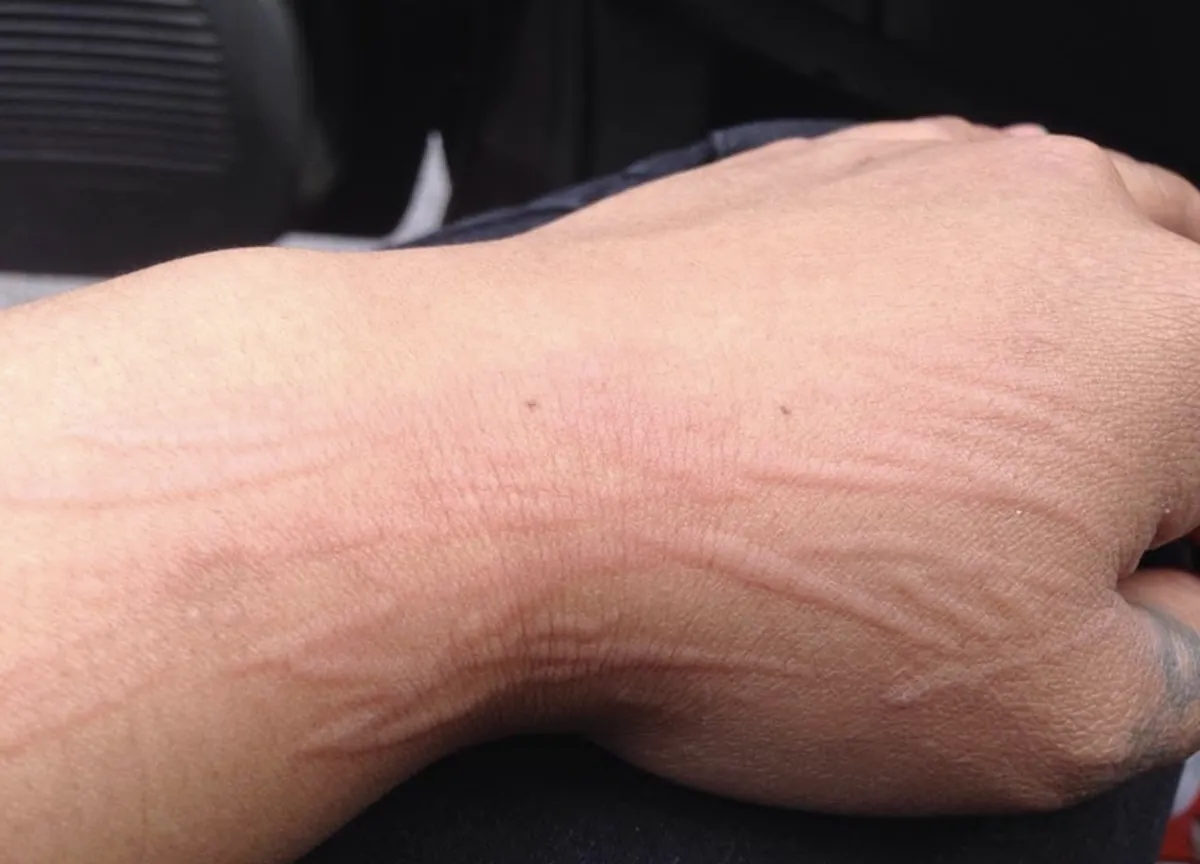
Short answerScratching mechanically destabilises mast cells in the skin, releasing histamine and other mediators. Histamine widens local blood vessels (redness), makes them leak fluid into the tissue (swelling), and stimulates itch nerves directly (more itching). In people with dermatographia the threshold for this response is unusually low, so ordinary pressure triggers a visible inflammatory reaction within minutes.
Redness is not damage
The first thing worth clearing up: when your skin goes red and swollen after a scratch, you have usually not injured it. Nothing is torn, nothing is bleeding, and nothing is infected. What you are looking at is an inflammatory response — the skin's alarm system firing, not the aftermath of harm.
That distinction matters, because it changes what helps. You do not need to protect a wound. You need to lower how easily the alarm goes off.
The chain reaction, step by step
Everything downstream comes from one event: mast cell degranulation. Here is the sequence, and roughly how long each step takes.
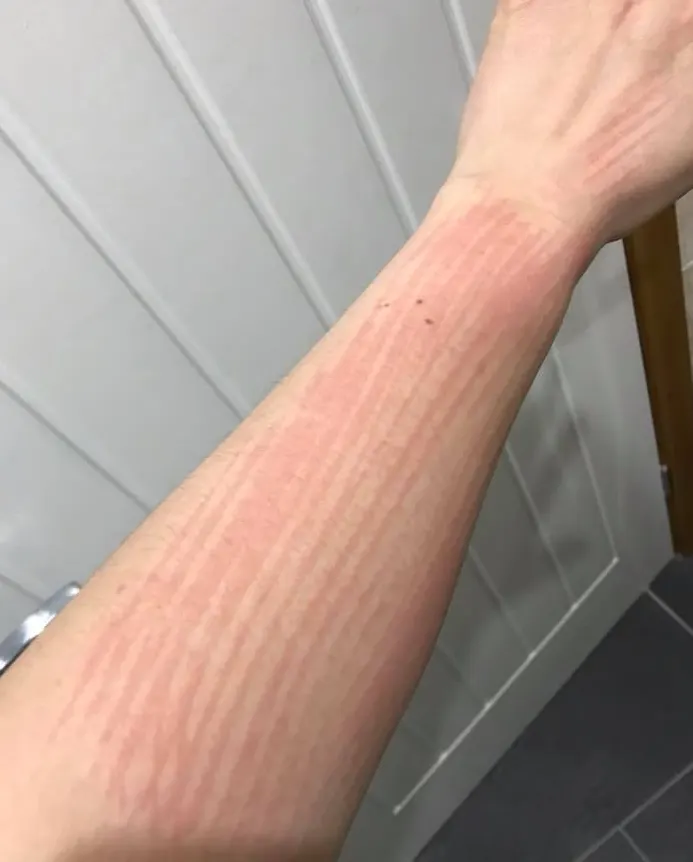
- 0 seconds — mechanical force. A fingernail, seam or strap deforms the skin and physically destabilises mast cells sitting in the dermis.
- 10–30 seconds — degranulation. Those cells dump stored histamine, tryptase and other mediators into the surrounding tissue.
- 30–90 seconds — vasodilation. Nearby capillaries widen. More blood in the area means visible redness, and the skin feels warm.
- 2–5 minutes — leakage. The widened vessels become permeable and fluid moves into the tissue. The area rises into a wheal.
- Throughout — itch signalling. Histamine binds H1 receptors on sensory nerves, which is why the scratched spot itches more than it did before.
- 15–60 minutes — resolution. Histamine is broken down, fluid drains back, and the skin returns to normal.
The flare, the wheal and the itch
Clinicians describe this as the triple response, and once you know the three parts you can see them in your own skin.
First a red line appears along the stroke. Then a broader red flare spreads either side of it, driven by a nerve reflex that dilates vessels beyond the point of contact. Then the centre rises into a pale, swollen wheal as fluid moves in — which is why a well-developed welt often looks white in the middle with red edges.
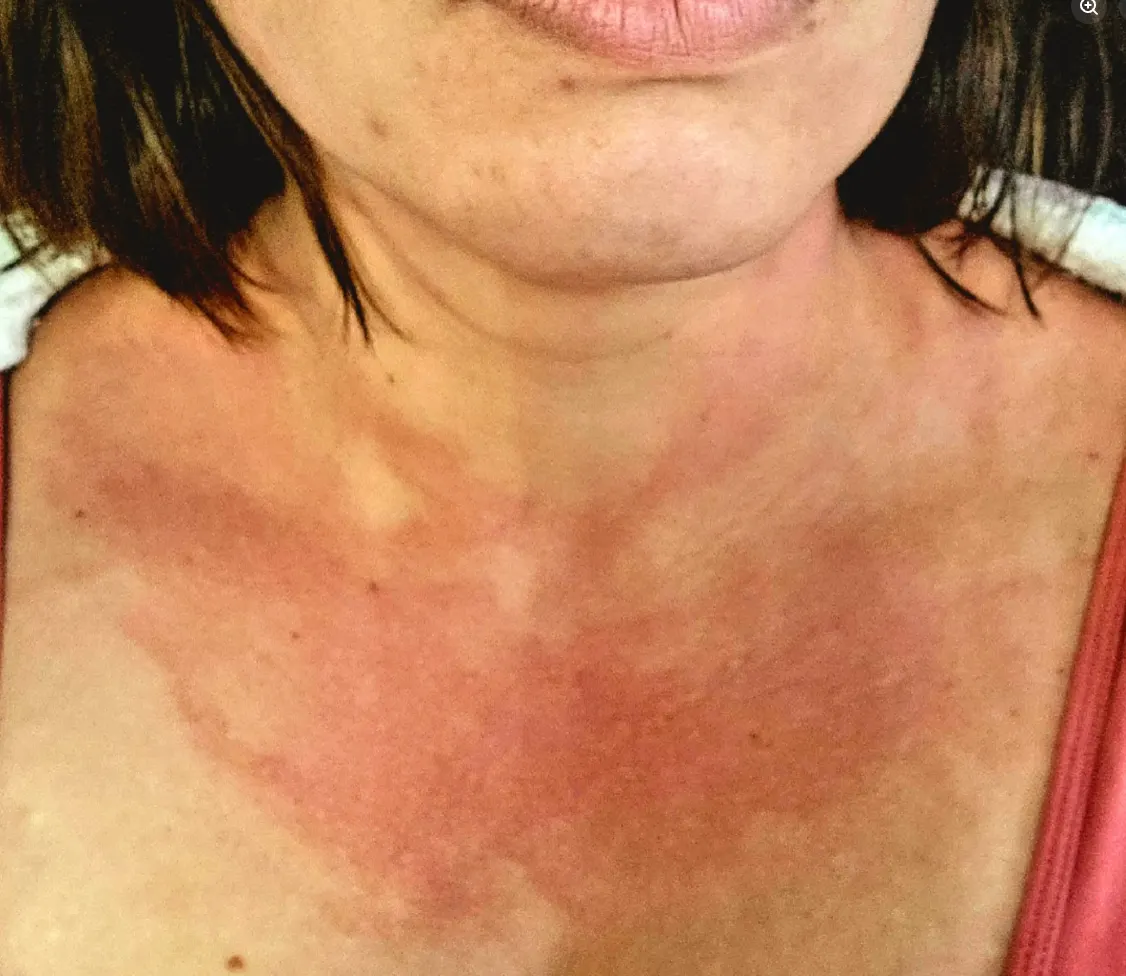
The flare is why a single scratch can turn a whole patch of skin red rather than just the line you drew. It is a neural reflex, not spreading damage.
Why yours reacts and someone else's does not
Everyone has this response. The difference is the threshold. A person without dermatographia needs substantial force to produce a visible wheal; someone with it needs almost none.
Several things move that threshold up and down day to day, which is why the same scratch produces a mild line on Tuesday and an angry welt on Thursday.
- Skin temperature — warm skin reacts harder. Hot showers, exercise and hot weather all lower the threshold.
- Dryness and a damaged barrier — dry skin itches sooner, gets scratched more, and provokes more easily.
- Sleep debt and stress — both reliably worsen the response, and both are the reason a bad week shows up on your skin.
- Antihistamine timing — receptors already blocked before the friction happens produce a much smaller reaction than a tablet taken afterwards.
- Recent illness or infection — a temporarily more reactive immune system shows up as more reactive skin.
The itch-scratch loop is the real problem
Scratching an itchy patch feels productive for about four seconds, and then it makes the area larger and itchier than it was. Repeat that a few times and a single itch becomes a twenty-minute episode across half a forearm.
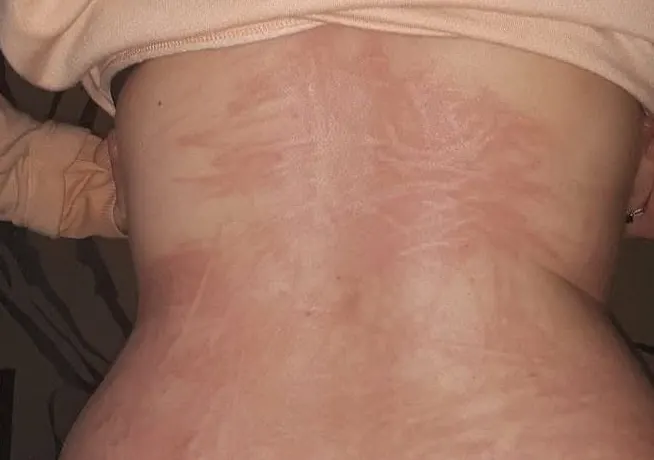
Night is where this does the most damage. You are not making a decision about whether to scratch, so nothing stops it, and people routinely wake up with inflamed lines across their back or stomach that they have no memory of making.
Things that genuinely help break the loop: cold. A cool compress or a cold pack constricts the dilated vessels and dampens the itch nerve signal at the same time, and unlike scratching it does not add more mechanical force. Short nails reduce how much force a reflexive scratch delivers. Pressing firmly on a spot, or tapping it, satisfies some of the urge without dragging across the skin.
What shortens the redness
There is no way to switch off an inflammatory reaction that is already underway, but three things reliably shorten it or reduce how often it starts.
- Cold, applied early. Ten minutes with a cool compress does more than anything topical.
- Preventive antihistamines. Second-generation H1 blockers taken daily, before the friction rather than after it, are first-line for this and are a clinician conversation.
- Barrier repair. A bland ceramide moisturiser on damp skin twice a day raises the itch threshold, which means less scratching to begin with.
What does not help
Topical steroids are widely prescribed for red itchy skin and do very little for a reaction driven by pressure minute to minute — by the time the cream is absorbed, the wheal has resolved on its own.
Hot water feels wonderful on an itchy patch for about thirty seconds and then makes the following hour worse, because heat lowers the reaction threshold. So does aggressive towel-drying, which is friction applied to skin you just warmed up.
And 'toughening the skin up' with more friction is precisely the wrong direction. There is no desensitising to this.
When inflammation means something else
Reactions that follow this pattern — minutes to appear, under an hour to clear, shaped like the pressure, no residue — are the pressure response described here. Step outside that pattern and it is worth an appointment.
Specifically: inflammation that persists past 24 hours in one place, skin that blisters, weeps, crusts or scales, a mark that leaves a lasting stain, or redness with fever, joint pain or fatigue. And urgently, any swelling of the lips, tongue or throat, or difficulty breathing.
Find out what's driving your dermatographia
Answer 12 quick questions and get a personalized severity score, your top drivers, and a staged 30-day plan built around your own skin.
Get My Dermatographia ScoreFrequently asked
- Why does my skin get inflamed when I scratch it?
- Mechanical pressure destabilises mast cells in the skin, which release histamine. Histamine widens local blood vessels and makes them leak fluid, producing redness, warmth and swelling within a few minutes. In dermatographia the threshold for this response is unusually low.
- Why does my skin turn red when scratched but not everyone else's?
- Everyone has the same underlying response; the difference is how much force it takes to trigger it. In dermatographia, the mast cells release histamine at a far lower level of pressure, so an ordinary scratch produces a visible reaction.
- How long should redness after scratching last?
- Usually 15 to 60 minutes. Warm skin, deeper pressure and a missed antihistamine dose can extend it. Redness lasting more than 24 hours in one spot is not a typical pressure reaction and should be assessed.
- Does scratching make the inflammation worse?
- Yes. Each scratch recruits more mast cells and releases more histamine, so the itchy area gets larger and itchier. Cold compresses, short nails and pressing rather than dragging all help break that loop.
- When is redness after scratching a reason to get seen?
- If the redness lasts more than a couple of hours, leaves a bruise or a brown stain, or comes with swelling of the lips, tongue or throat, get it looked at. Ordinary dermatographia redness fades without leaving anything behind.
Sources
Clinical background on this page is checked against the following published sources. My own experience and interviews are labelled as such in the text.