What Is Dermatographia? A Plain-Language Guide to Skin Writing
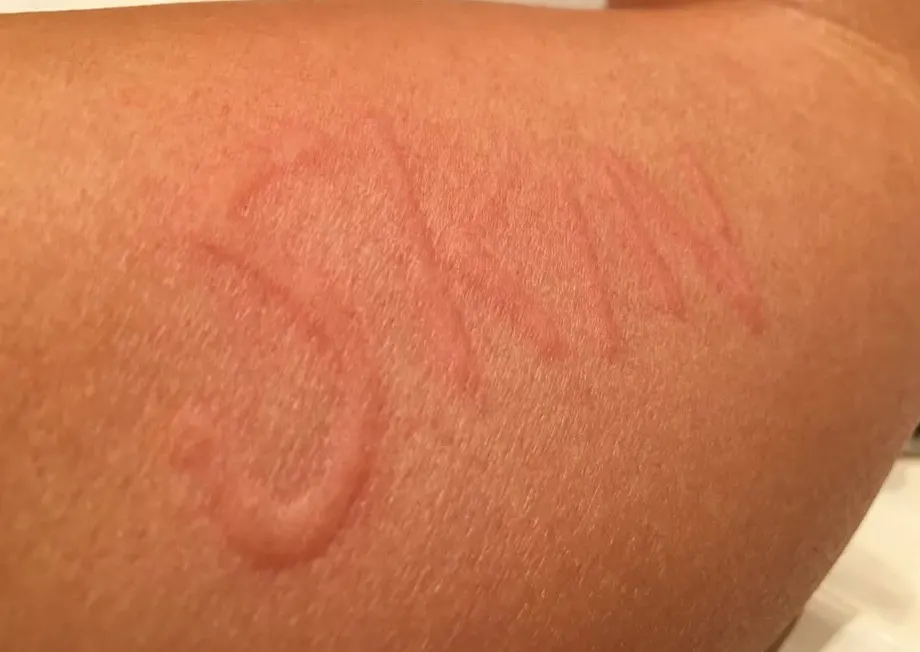
Short answerDermatographia (dermatographism, or 'skin writing') is a common physical urticaria in which light pressure on the skin produces a raised, red, itchy welt within minutes. It affects roughly 2–5% of people, is not contagious, is not dangerous, and the welts usually fade within 15–60 minutes.
The one-sentence definition
Dermatographia is a form of physical (inducible) urticaria where the trigger is mechanical: stroking, scratching, rubbing, or sustained pressure. The skin responds with a wheal-and-flare reaction that literally traces the line of pressure, which is why people can write words on their arm and watch them rise.
The medical literature also calls it dermatographism, dermographism, or factitious urticaria. All four terms describe the same reaction.
What a flare looks and feels like
A typical episode follows the same arc every time, which is one of the ways clinicians recognise it.
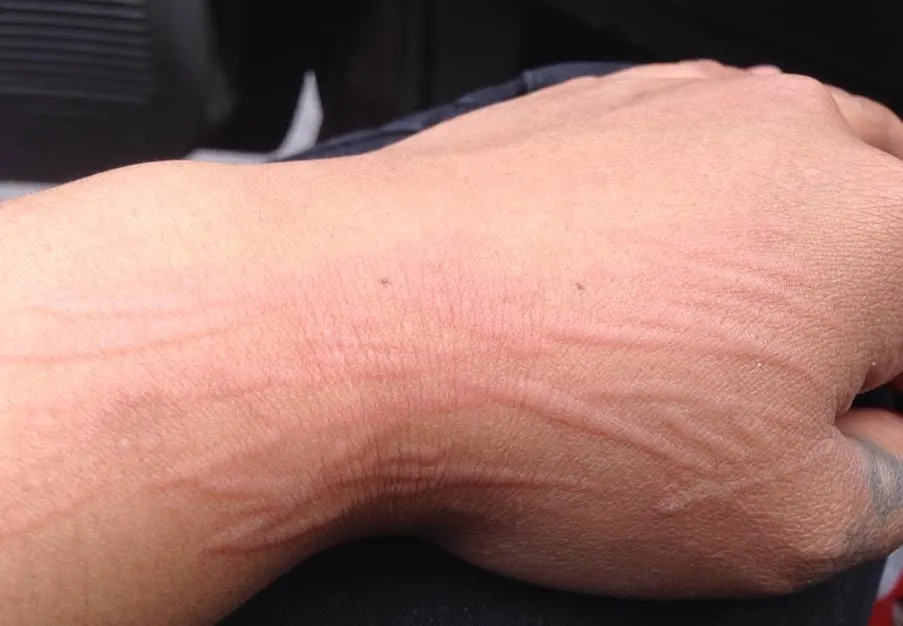
- Within 1–3 minutes: a pink or red line appears exactly where pressure was applied.
- Within 5–15 minutes: the line lifts into a raised wheal and itching peaks.
- Within 15–60 minutes: the wheal flattens and the colour drains, usually leaving no mark.
- Itch is the symptom most people find hardest — the visual is often milder than the sensation.
Who gets it
Dermatographia is most often first noticed in the teens through the thirties, and affects all skin tones — although on deeper skin tones the wheal is easier to see than the redness, so the raised texture matters more than colour when identifying it.
Most cases are idiopathic, meaning no single underlying cause is found. It can appear after an infection, a period of high stress, a course of medication, or for no identifiable reason at all.
How it is diagnosed
Diagnosis is usually a two-minute in-office test: a clinician strokes the forearm with a tongue depressor or a dermographometer and watches for a wheal within a few minutes. No biopsy or blood test is required for a typical presentation.
Tests are sometimes added not to diagnose dermatographia but to rule out other causes of chronic hives — a different condition with different management.
What it is not
It is not contagious, not caused by poor hygiene, and not a skin infection. It does not scar in its typical form, and it is not an allergy — although it shares the histamine pathway with allergic reactions, which is why antihistamines help.
Living with it day to day
Most people manage dermatographia with a combination of three levers: a consistent preventive antihistamine routine agreed with a clinician, removing physical friction from clothing and bags, and protecting the skin barrier so it tolerates more before it reacts.
How common is dermatographia, really?
Estimates put dermatographia at roughly 2-5% of the population, which makes it one of the more common physical urticarias, yet most people who have it never see a dermatologist for it. Mild cases are easy to write off as 'sensitive skin', so the true number is probably higher than the studies suggest.
I was formally diagnosed in 2008 after years of assuming everyone's skin welted up like mine did when a seatbelt sat across it. A GP ran a tongue depressor down my forearm, watched the line rise in under two minutes, and gave the reaction a name I had never heard before.
How it differs from other physical urticarias
Dermatographia sits in a family of conditions that clinicians group together as inducible or physical urticarias, because each is set off by a specific external trigger rather than appearing spontaneously. Telling them apart matters because the management can differ slightly.
- Dermatographia: triggered by stroking or scratching; the wheal follows the exact line of contact within minutes.
- Cholinergic urticaria: triggered by a rise in body heat such as exercise or a hot shower; appears as small, intensely itchy bumps rather than lines.
- Delayed pressure urticaria: triggered by sustained pressure, but swelling starts hours later and can last a day or more.
- Cold urticaria: triggered by cold exposure, with welts appearing on rewarming.
Grading severity
Not every case looks the same, and severity tends to shift over time for the same person. Clinicians and patients alike find it useful to think in three rough bands.
- Mild: occasional faint lines from firm scratching, rarely itchy enough to notice.
- Moderate: regular welts from everyday friction like waistbands or towels, itch that interrupts concentration.
- Severe: near-constant welting from light touch, visible marks most days, and itch that disturbs sleep.
Red flags that are not typical dermatographia
Straightforward skin writing follows a reliable pattern, so it is worth knowing what falls outside it. If your welts last more than 24 hours, leave bruising or discolouration behind, or come with fever, joint pain, or breathing symptoms, that points toward a different condition and deserves a proper clinical review rather than self-diagnosis from a photo online.
A practical routine for tracking your own pattern
If you suspect you have dermatographia, or you already know you do and want to understand it better, a simple two-week log is more useful than trying to remember flares afterwards. Note the date and time, what touched your skin, how long the wheal took to rise, and how long it took to fade. You do not need special equipment — a notes app and a timestamped photo are enough.
Over a fortnight, patterns usually emerge that are invisible day to day: perhaps your skin is worse in the evening, worse after a hot shower, or calmer on days you slept well. That log is also the single most useful thing you can bring to a first appointment, because it turns 'my skin does this sometimes' into something a clinician can actually act on.
What I tried that didn't help
In my own case, I spent a fair amount of the first year chasing things that made no real difference: cutting out entire food groups, switching to increasingly 'natural' soaps, and buying expensive moisturisers on the theory that a premium price meant a better barrier effect. None of it moved the needle in any way I could measure once I started actually logging flares.
What did help was boring and consistent: a daily antihistamine taken at the same time every day, loosening a few pieces of clothing, and being patient with a skin barrier that took longer than I expected to calm down. If you're early in figuring this out, it's worth being sceptical of anything that promises a fast fix.
What to expect over the following months
For most people the first few months are the most disruptive, simply because you are still learning what triggers your particular skin and you haven't yet built the small daily habits that keep it calm. That intensity typically eases as the routine becomes automatic rather than something you have to think about.
It is normal for symptoms to fluctuate rather than improve in a straight line — a stressful week or a bout of illness can bring flares back even after months of calm skin. That is not a sign your management has stopped working; it is simply how a threshold-based condition behaves.
Related reading
If this was useful, these go deeper on the questions people ask next.
Find out what's driving your dermatographia
Answer 12 quick questions and get a personalized severity score, your top drivers, and a staged 30-day plan built around your own skin.
Get My Dermatographia ScoreFrequently asked
- Can dermatographia do any lasting harm to the skin?
- In its typical form it is uncomfortable but harmless. Seek urgent care if welts are ever accompanied by lip or tongue swelling, wheeze, or difficulty breathing — that is a different, emergency reaction.
- Is dermatographia permanent?
- It fluctuates. Many people have it for months to a few years and then find it fades; others live with it long-term, with periods of near-total remission in between.
- Does dermatographia run in families?
- There is not strong evidence of a single inherited gene, but clinicians do see it cluster in families alongside other atopic or urticarial conditions. If a parent or sibling has it, that is a mild risk factor, not a certainty.
- Can children get dermatographia?
- Yes, though it is most commonly first noticed in the teens and twenties. In children it is managed the same way; a paediatrician can confirm the stroke test and advise on age-appropriate antihistamine dosing.
- Does dermatographia get worse with age?
- Not predictably. Some people find it intensifies during hormonal transitions or high-stress decades and eases later; others notice no age-related pattern at all.
- How long does it take to notice if a change is helping?
- Give any single change — a new antihistamine routine, a clothing swap, a moisturising habit — at least two to three weeks before judging it, since day-to-day fluctuation can otherwise look like a trend that isn't really there.
- Do I need a diagnosis if I already know what this is?
- A confirmed diagnosis is still worth having. It takes one stroke test in the office, it rules out the other causes of hives that look similar, and it is what unlocks a prescription-strength antihistamine plan if you ever need one.
Sources
Clinical background on this page is checked against the following published sources. My own experience and interviews are labelled as such in the text.