Dermatographia Urticaria: What the Full Name Actually Means

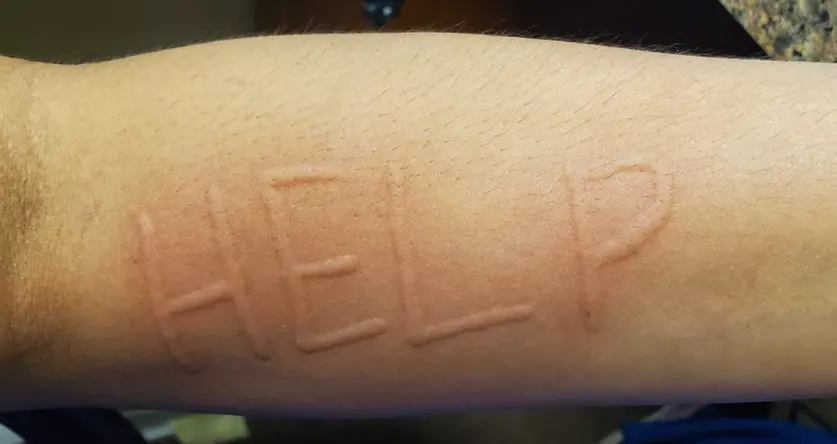
Short answerDermatographia urticaria is the full clinical name for skin writing: 'dermatographia' means writing on the skin, and 'urticaria' means hives. Dermatographism, dermographism, urticaria factitia, factitious urticaria and symptomatic dermographism all describe the same condition. 'Dermatography' is a common misspelling — the actual medical term for a different practice, cosmetic medical tattooing.
Why there are so many names for one condition
Few conditions collect synonyms the way this one does. Search for it and you will find at least six spellings and terms, used interchangeably by different specialties, textbooks and countries. It makes an already confusing diagnosis harder to research.
The short version: they all mean the same thing. But knowing which term your dermatologist, your notes, or a research paper is using saves a lot of second-guessing.
Breaking the term down
'Dermatographia' comes from the Greek derma (skin) and graphein (to write) — literally, writing on the skin. 'Urticaria' comes from the Latin urtica, meaning nettle, and describes the raised itchy wheals that a nettle sting produces.
Put together, dermatographia urticaria means hives produced by writing or stroking the skin. That name describes the mechanism precisely: the trigger is mechanical, and the result is a wheal.
Every name you will encounter
Here is the full glossary, with where each term tends to show up.
- Dermatographia — the most common spelling in US-facing patient material and the one most people search for.
- Dermatographism — the same word in its '-ism' form; very common in American clinical notes and textbooks.
- Dermographism — the shortened spelling, dominant in UK and European literature. Same condition, one syllable less.
- Symptomatic dermographism — the term specialists use when the reaction actually itches. Some people wheal on stroking with no itch at all, which is called simple dermographism and generally needs no treatment.
- Urticaria factitia — the Latin form, still used in German and other European literature. 'Factitia' means made or produced, referring to the fact that the hives are induced rather than spontaneous.
- Factitious urticaria — the English form of the same term. Note that it means 'induced', not 'faked' — an unfortunate overlap with the everyday sense of the word.
- Inducible urticaria / physical urticaria — the umbrella category dermatographia belongs to, alongside cold urticaria, cholinergic urticaria and delayed pressure urticaria.
'Dermatography' is a different thing entirely
One of the most common searches around this condition is 'dermatography', and it is almost always a near-miss for dermatographia. Worth knowing what it actually refers to, because the search results will look confusing.
Dermatography is the medical term for cosmetic or medical tattooing — pigment implanted into the skin to restore appearance after surgery, scarring or areola reconstruction. It has nothing to do with hives.
If you landed here searching for 'dermatography' and what you meant was the condition where scratching your skin leaves raised marks, you are in the right place. Other frequent near-misses include 'dermatographia hives', 'skin writing disease', and 'dermographia'.
Simple vs symptomatic dermographism — the one distinction that matters
Of all the terms above, this is the only pair that describes a real clinical difference rather than a naming preference.
Simple dermographism: stroking the skin produces a visible wheal, but it does not itch and does not bother the person. It is present in a meaningful slice of the general population — many people discover it by accident and never think about it again. No treatment needed.
Symptomatic dermographism: the same wheal, but it itches, and the itch interferes with sleep, clothing choices or daily life. This is the version that gets diagnosed, treated, and discussed on this site.
If your clinician writes 'symptomatic dermographism' in your notes, that is not a different diagnosis from what you read about as dermatographia. It is the precise term for the itchy version.
Where dermatographia sits in the urticaria family
Urticaria as a whole splits into two broad groups, and knowing which side you are on shapes what your treatment looks like.
- Spontaneous urticaria: hives appear without an identifiable external trigger. When this continues beyond six weeks it is called chronic spontaneous urticaria.
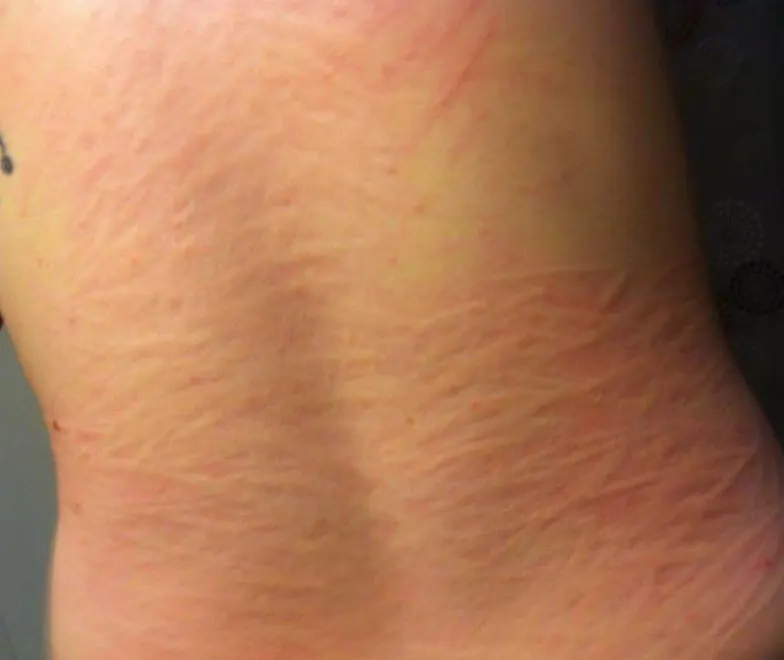
- Inducible urticaria: hives appear only in response to a specific physical trigger. Dermatographia is the most common member of this group; others include cold, heat, pressure, vibration, water and sun-induced urticaria.
- Some people have both at once, which is one reason a careful history matters more than any single test.
How to talk about it with a clinician
You do not need to use the Latin. Describing the pattern gets you further than naming it: 'when I scratch my skin, a raised itchy line appears within a couple of minutes and fades within an hour.' Any clinician who has seen it will recognise that description immediately, and confirming it takes one stroke of a tongue depressor.
If you want a term to bring, 'symptomatic dermographism' is the most precise one and signals you have done your reading.
Related reading
If this was useful, these go deeper on the questions people ask next.
Find out what's driving your dermatographia
Answer 12 quick questions and get a personalized severity score, your top drivers, and a staged 30-day plan built around your own skin.
Get My Dermatographia ScoreFrequently asked
- What is dermatographia urticaria?
- It is the full clinical name for skin writing — hives (urticaria) produced by stroking or scratching the skin (dermatographia). Light mechanical pressure causes mast cells to release histamine, producing a raised, itchy line within minutes that usually fades within an hour.
- Is dermatographism the same as dermatographia?
- Yes. Dermatographia, dermatographism, dermographism, urticaria factitia and factitious urticaria all describe the same condition. The variation is regional and stylistic, not clinical.
- What is the difference between simple and symptomatic dermographism?
- Simple dermographism produces a visible wheal on stroking but no itch and needs no treatment. Symptomatic dermographism produces the same wheal with itch that affects daily life, and is the version that is diagnosed and treated.
- Is dermatography the same as dermatographia?
- No. Dermatography is a term for cosmetic and medical tattooing. It is a very common misspelling of dermatographia, the skin-writing condition, but the two are unrelated.
- Which specialist handles this — dermatology or allergy?
- Either. Dermatologists and allergists both manage chronic inducible urticaria, and the choice is usually whichever you can get in to see sooner. Ask for the one with a chronic urticaria interest if the clinic lists it.
Sources
Clinical background on this page is checked against the following published sources. My own experience and interviews are labelled as such in the text.