Dermatographia vs Hives: How to Tell the Difference
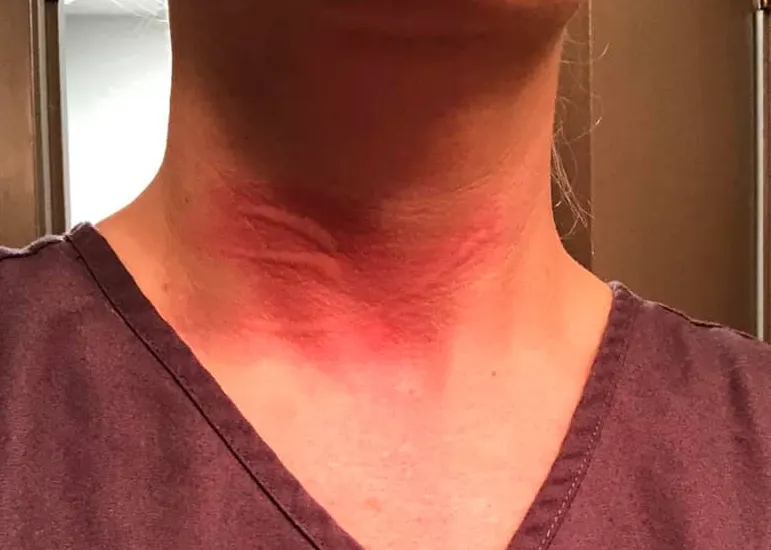
Short answerDermatographia welts follow the exact line of pressure and fade within about an hour; ordinary hives appear spontaneously in random shapes, can last several hours, and are not reproducible by scratching.
The reproducibility test
The distinguishing feature of dermatographia is that a clinician can reproduce it on demand: a firm stroke with a blunt instrument produces a matching linear wheal within a few minutes. Spontaneous hives cannot be drawn on.
This is genuinely one of the more satisfying moments of getting diagnosed. After years of being told welts were 'probably stress' or 'probably an allergy,' watching a dermatologist draw a line on my arm with a tongue depressor and watching it rise exactly where they had drawn it felt like finally being believed.
Shape, timing, and duration
Side by side, the two look quite different:
- Dermatographia: linear, matches the pressure that caused it, appears in 2 to 5 minutes, fades in 15 to 60 minutes.
- Spontaneous urticaria: round or map-shaped patches, appears without an obvious mechanical cause, often lasts 2 to 24 hours.
- Angioedema: deeper swelling of lips, eyelids, or hands — this warrants prompt medical attention.
When to see a clinician
Book an appointment if welts last longer than 24 hours, leave bruising, come with fever or joint pain, or if you have any swelling of the lips, tongue, or throat, or difficulty breathing — the last of those is an emergency.
Why the confusion happens so often
Both conditions sit under the umbrella term urticaria, and both are driven by the same mast cell and histamine pathway, which is exactly why they get lumped together in casual conversation. The confusion is understandable: from a distance, a raised, itchy, red welt looks like a raised, itchy, red welt, whatever caused it.
The practical difference matters because treatment overlaps but the self-management does not. With dermatographia, avoiding known mechanical triggers meaningfully reduces flares. With spontaneous hives, there is often no clear physical trigger to avoid, so management leans more heavily on medication and identifying less obvious triggers like infections, medications, or, occasionally, underlying conditions a clinician would investigate.
Can you have both diagnoses correctly at once?
Yes, and it is more common than people assume. Someone with chronic spontaneous urticaria may also have a positive dermatographism test, and the two conditions are tracked separately in clinical notes because they behave differently and can respond differently to treatment adjustments.
If your welts sometimes appear where you know you scratched and sometimes appear seemingly out of nowhere, mention both patterns to your clinician rather than assuming it is all one thing. It changes how they think about your case.
A simple way to describe your welts to a doctor
Doctors appreciate specifics far more than general descriptions like 'my skin gets itchy.' Before an appointment, it helps to be ready to describe roughly how long a welt takes to appear, how long it lasts, whether it follows a shape you caused (a scratch, a strap, a seam) or appears with no obvious cause, and whether it has ever come with swelling of the face, lips, or throat.
How diagnosis is actually confirmed
For dermatographia specifically, diagnosis is largely clinical: a doctor takes a history, then performs the simple stroke test described earlier and times the response. Blood tests and allergy panels are not usually needed for classic dermatographia, though a clinician may still order them if your history suggests something else could be contributing, such as a thyroid condition or an underlying chronic urticaria that needs separate evaluation.
For spontaneous hives, diagnosis relies more heavily on the history of when and how welts appear, since there is no equivalent on-the-spot test to reproduce them. This is exactly why keeping notes on timing and appearance is so valuable before an appointment.
Related reading
If this was useful, these go deeper on the questions people ask next.
Find out what's driving your dermatographia
Answer 12 quick questions and get a personalized severity score, your top drivers, and a staged 30-day plan built around your own skin.
Get My Dermatographia ScoreFrequently asked
- Can you have dermatographia and hives at the same time?
- Yes. Inducible and spontaneous urticaria frequently coexist, which is one reason a clinician will ask you to describe both the shape and the duration of your welts.
- Is dermatographia contagious?
- No. It is a response of your own skin's mast cells and cannot be passed to anyone else.
- Does a dermatographism test hurt?
- It is generally described as mildly uncomfortable at most, similar to a firm scratch, and takes only a few minutes to read the result.
- Can hives without a known cause ever turn into dermatographia?
- They are considered separate patterns rather than one evolving into the other, though it is common for someone to notice both over time as their skin's sensitivity changes.
- Should I photograph my welts before a doctor's visit?
- Yes, photos taken at the time of a flare, with a note of how long it had been there, are genuinely useful since welts often fade before an appointment happens.
Sources
Clinical background on this page is checked against the following published sources. My own experience and interviews are labelled as such in the text.