Mast Cell Science Explained
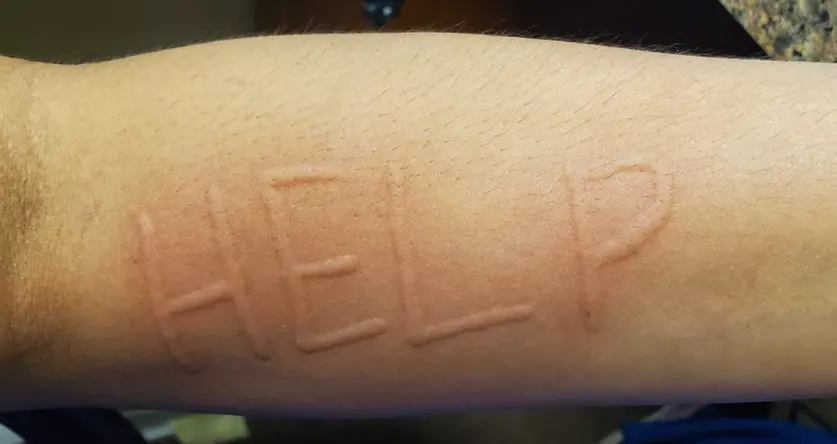
Short answerDermatographia happens when mechanical pressure destabilizes skin mast cells, releasing histamine that widens local blood vessels and creates a raised wheal within minutes.
What a mast cell actually does
Mast cells are immune cells that sit in the dermis, clustered around blood vessels and nerve endings. They store granules packed with histamine, tryptase, and other mediators, ready to release the moment they are triggered.
In most people those granules stay put under ordinary friction. In dermatographia the threshold is far lower: the mechanical force of a fingernail, a seam, or a backpack strap is enough to make the cell degranulate.
I remember the first time a doctor actually drew a tongue depressor across my forearm in the exam room and we both just watched the line rise in real time. It sounds dramatic, but for those of us living with this, it is just Tuesday. The interesting part, once you get past the itch, is how orderly the biology actually is underneath what looks like a chaotic skin reaction.
The three-part wheal-and-flare response
What you see on the skin follows a predictable sequence, first described as the triple response:
- Redness — histamine dilates the smallest capillaries under the scratch line.
- Flare — a nerve reflex spreads the redness a few millimetres either side of the line.
- Wheal — fluid leaks out of the leaky vessels into the skin, lifting the line into a raised welt.
Why it fades
Histamine is broken down quickly by enzymes in the skin. Once the release stops, the vessels tighten, the leaked fluid is reabsorbed, and the welt flattens. For most people that whole cycle runs 15 to 60 minutes.
This is also why antihistamines help: they do not stop the mast cell from releasing histamine, they block the receptors histamine would otherwise activate.
What triggers the trigger
Mast cells do not degranulate for no reason. Clinicians and researchers generally believe mechanical deformation of the mast cell membrane itself is enough to set off the cascade in susceptible skin, though the exact molecular switch is still debated. Some people also notice their threshold moves around with stress hormones, temperature, or hormonal cycles, which suggests the mast cell's sensitivity is not fixed — it is more like a dial that other systems in the body can turn.
That variability is frustrating if you are trying to find one single cause, but it is also somewhat reassuring: it means the condition is modulated by things you can actually influence, like sleep, stress load, and skin temperature, even if you cannot switch the underlying tendency off completely.
How this differs from a true allergic reaction
It helps to separate dermatographia from a classic allergy, even though both run through the same mast cell machinery. In a food or pollen allergy, the immune system has built specific IgE antibodies against a particular protein, and exposure to that exact protein is what triggers the mast cell. In dermatographia, no specific allergen is required at all — plain mechanical pressure is the whole story for most people.
That distinction matters practically. It means allergy testing is often unhelpful for isolated dermatographia unless a clinician suspects a separate allergic condition is also present. What actually helps is understanding your personal pressure and heat thresholds and working around them.
How researchers study mast cell thresholds
Clinicians sometimes use a tool called a dermographometer, a spring-loaded pen that applies a controlled, measured amount of pressure, to work out roughly how sensitive someone's skin is and to track whether it changes over time or with treatment. It is a simple piece of kit, but it turns a vague symptom into something a clinic can actually measure and compare visit to visit.
Research into why some people have such a low mechanical threshold is ongoing, and there is no single accepted answer yet. Some studies have looked at differences in mast cell density in skin, others at nerve signalling, and others at whether skin barrier changes play a role. None of this is settled science, so it is worth being wary of anyone presenting a single tidy explanation as definitive.
Living with a low threshold, day to day
Once you understand the biology, the day-to-day management stops feeling random. I stopped fighting the idea that a towel rubbed too briskly across my back would leave a pattern, and started just patting dry instead. Small adjustments like that reduce how often the mast cells actually get the mechanical nudge they need to fire.
None of this replaces a proper diagnosis or treatment plan from a clinician, especially if your welts last longer than an hour or come with swelling elsewhere on the body. But understanding the mechanism made the whole condition feel less like a mystery and more like a manageable quirk of my own skin.
Find out what's driving your dermatographia
Answer 12 quick questions and get a personalized severity score, your top drivers, and a staged 30-day plan built around your own skin.
Get My Dermatographia ScoreFrequently asked
- Is dermatographia an allergy?
- No. It is a physical urticaria — the trigger is mechanical pressure, not an allergen. The mast cell pathway is shared with allergic reactions, which is why antihistamines can still help.
- Does scratching make dermatographia worse over time?
- Repeated scratching keeps triggering degranulation and can extend a flare, but it does not cause permanent damage or scarring in typical dermatographia.
- Can stress alone cause a mast cell reaction without touch?
- Stress does not usually trigger dermatographia on its own, but many people notice it lowers the pressure threshold, so a light touch that normally would not react suddenly does.
- Why does heat make wheals bigger?
- Warmth dilates blood vessels on its own, which adds to the histamine-driven dilation and tends to make wheals rise higher and last a little longer.
- Do mast cells ever run out of histamine?
- They can be temporarily depleted after a large or repeated reaction, which is one reason a second scratch in the same spot minutes later sometimes produces a smaller wheal.
Sources
Clinical background on this page is checked against the following published sources. My own experience and interviews are labelled as such in the text.