Skin Writing (Dermatographia): Pictures, Causes and Treatment
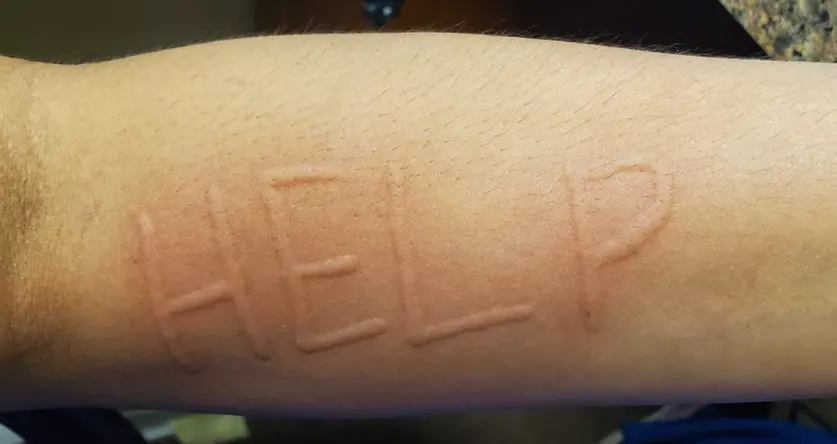
Short answerSkin writing — known medically as dermatographia or dermatographic urticaria — is a condition where raised welts appear along any line drawn on the skin, because mechanical pressure makes skin mast cells release histamine along exactly that path. Words written with a fingernail rise within a few minutes and usually fade within an hour. It is harmless, it is not contagious, and it is treated with second-generation antihistamines plus reducing friction and heat.
Why the line is so precise
Mast cells degranulate only where the mechanical force was applied, and histamine diffuses just a few millimetres. That short diffusion distance is what keeps the edges of a letter crisp instead of blurring into a patch.
The timeline of a written word
Every drawing follows the same clock, which is why the photos below look alike.
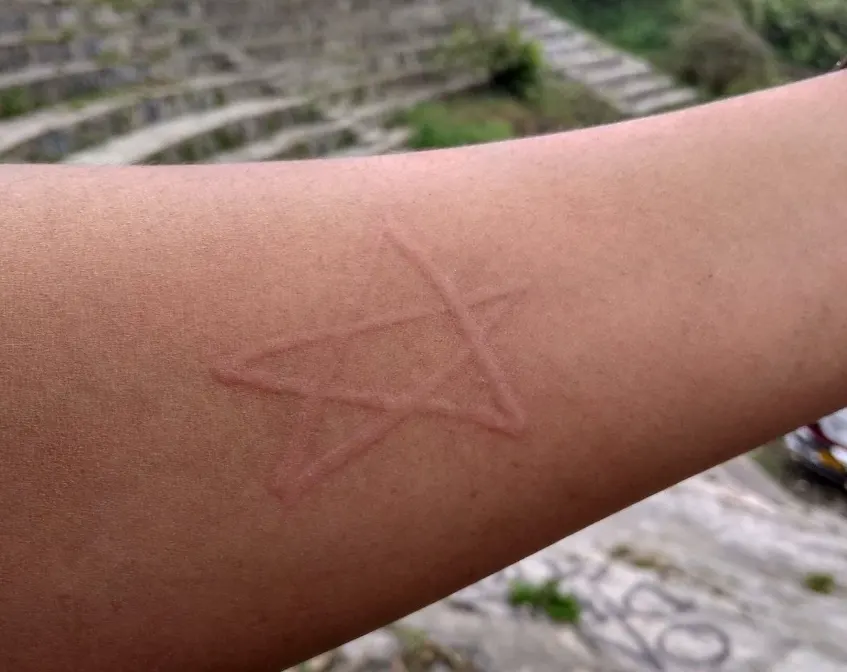
- 0–2 minutes: a faint pink outline.
- 3–10 minutes: the letters rise and become legible from across a room.
- 10–30 minutes: peak height and peak itch.
- 30–60 minutes: the word softens and disappears, usually leaving nothing behind.
Is it safe to write on your skin?
For most people an occasional demonstration is harmless. The catch is the itch that follows: a drawing you make for a photo can leave twenty minutes of itching that leads to more scratching and a wider flare. Use light pressure, and never break the skin.
Photographing it well
Diffuse natural light, a plain background, and a shot taken 8–12 minutes in will capture the wheal at its clearest. Timestamps matter if you are documenting flares for a clinician.
Why some people write more dramatically than others
The height and duration of a written wheal roughly tracks overall reactivity, so someone in an active flare period will get a far more dramatic result than the same person on a calm week. This is why demonstration videos online can look wildly different between people, or even for the same person on different days.
What clinicians actually use skin writing for
Beyond curiosity, the controlled version of this — a dermographometer applying a fixed, calibrated pressure — is a genuine diagnostic tool. It lets a clinician grade severity consistently rather than relying on a subjective fingernail stroke, which matters when tracking whether treatment is working over months.
A practical routine if you want to demonstrate it safely
If you want to show someone what skin writing looks like, a few small habits keep it from turning into an unwanted flare. Use the blunt edge of something smooth, like a capped pen or a fingernail with light pressure, rather than anything that could break the skin. Write somewhere easy to leave alone afterwards, like a forearm rather than a spot you'll keep brushing against clothing.
Take the photo somewhere in the 8 to 12 minute window after writing, since that's usually when the wheal is most raised and clearest, and then leave the area alone. Resist the temptation to re-trace the letters to make them more dramatic for a photo — that just adds more histamine release and more itching for no real benefit.
What I've noticed after years of living with it
Over two decades I've noticed my own skin writing is a fairly reliable barometer of how reactive my skin is generally. On a calm week, a fingernail stroke barely rises. During a flare period, even light contact raises a clear line within a minute or two. I've started using it, informally, as a quick check on how my broader management is going, rather than something I do for demonstration.
I've also learned not to let other people 'test' it repeatedly out of curiosity. A single demonstration is fine; being talked into writing several times in a row for an audience usually means an evening of itching I didn't need.
Common myths about skin writing
A few things people assume aren't accurate: that only very pale skin shows it clearly (raised texture is visible on any skin tone, even where redness is less obvious), that it means the immune system is 'overactive' in a dangerous way (it's a local mechanical response, not a systemic immune problem), and that practising it will make skin less reactive over time (if anything, repeated triggering tends to keep the itch-scratch cycle going).
When an unusual pattern needs a clinician's opinion
Typical skin writing rises within minutes and fades within an hour without bruising. If a written mark instead blisters, leaves a bruise, takes more than a day to fade, or is accompanied by pain rather than itch, that's outside the usual pattern and worth having looked at rather than assumed to be ordinary dermatographia.
Related reading
If this was useful, these go deeper on the questions people ask next.
Find out what's driving your dermatographia
Answer 12 quick questions and get a personalized severity score, your top drivers, and a staged 30-day plan built around your own skin.
Get My Dermatographia ScoreFrequently asked
- Can everyone write on their skin?
- No. A mild reaction is common, but a legible raised wheal within minutes indicates dermatographia, which affects a minority of people.
- Does skin writing leave scars?
- Not in typical dermatographia. Marks that persist beyond a day, bruise, or leave pigment should be reviewed by a clinician.
- Why does the raised welt sometimes stay pink after the swelling goes down?
- A faint pink or red mark can linger briefly after the raised wheal flattens as blood vessels return to normal; it usually fades within an hour and does not indicate skin damage.
- Can skin writing be used to prank or scare someone?
- It is sometimes used that way since it looks dramatic, but repeated deliberate scratching to produce a display can prolong itching and irritation for the person with dermatographia, so it is worth doing sparingly.
- Does skin writing hurt?
- Typically no — the dominant sensation is itching rather than pain. Pain with a raised mark is not typical and is worth mentioning to a clinician.
- Can I use skin writing to check if my treatment is working?
- Informally, yes — many people notice how easily and how high a line rises tracks with how reactive their skin is generally, though it's not a substitute for a clinician's calibrated assessment over time.
- Is the skin writing test something a doctor should do, or can I do it myself?
- You can reproduce it at home and it will look the same, but a clinician does it as part of a wider check — looking at how long the wheal lasts, whether it blanches, and whether anything else is going on. Bring a photo if your marks fade before the appointment.
Sources
Clinical background on this page is checked against the following published sources. My own experience and interviews are labelled as such in the text.