Do I Have Dermatographia? The At-Home Skin Writing Test
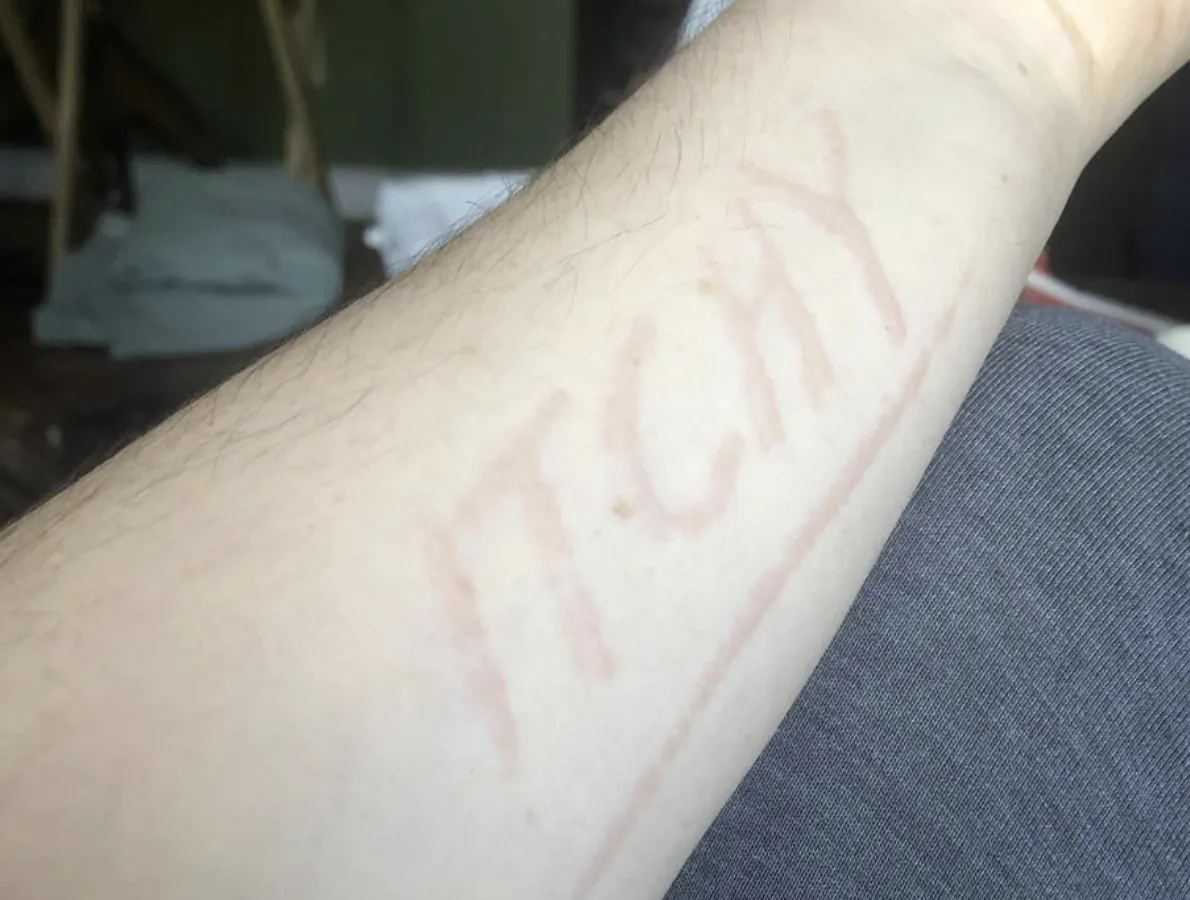
Short answerYou can check for dermatographia by firmly stroking a line on your inner forearm with a blunt object such as a pen cap and watching for five to ten minutes. A raised, red, itchy welt that follows the exact path of the stroke and fades within an hour is the classic positive result — but only a clinician can diagnose it.
The test in five steps
This is the same stroke test a dermatologist performs in clinic, minus the calibrated instrument. It costs nothing and takes ten minutes.
- Pick clear skin on your inner forearm, away from any existing rash.
- Use something blunt — a pen cap, the edge of a fingernail, a tongue depressor. Never anything sharp.
- Draw one firm straight line about 10 cm long. Firm pressure, one pass, do not saw back and forth.
- Start a timer and leave the skin completely alone.
- Photograph the line at 2, 5, 10 and 30 minutes with the same lighting.
What a positive result looks like
In dermatographia the response follows a recognisable sequence. Within about a minute a red line appears along the stroke. Over the next few minutes redness spreads slightly either side of it. Then the line itself lifts into a raised welt you can feel with a fingertip, usually accompanied by itch.
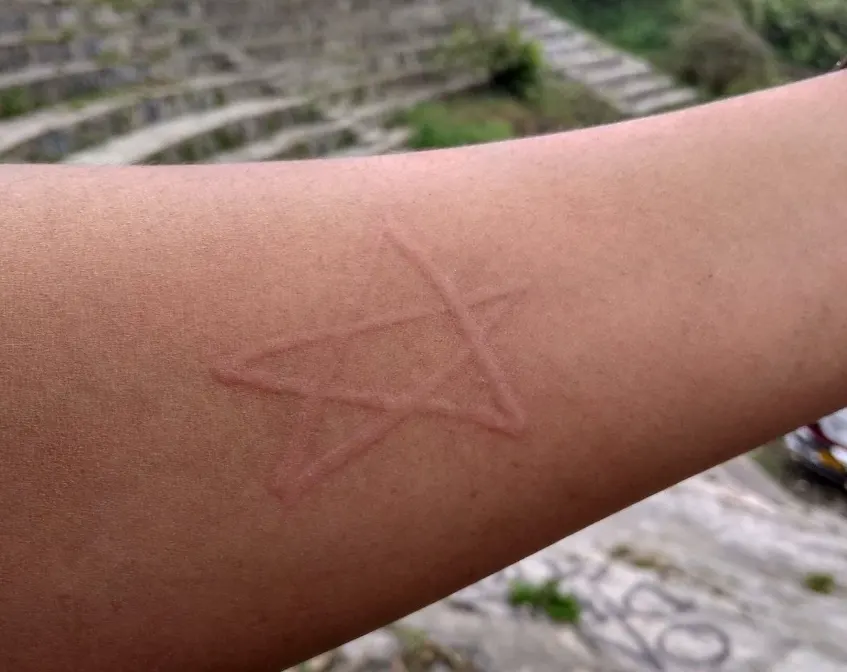
The defining feature is that the welt traces the stroke precisely. Scratch a shape and the shape appears. That reproducibility is what separates this from ordinary skin redness, which is diffuse and flat.
Reading your result
Timing matters as much as appearance. Use this to interpret what you photographed.
| What you see | Timing | What it suggests |
|---|---|---|
| Raised itchy welt tracing the line exactly | Rises in 5–10 min, gone within an hour | The classic symptomatic dermatographia pattern. |
| Red line, flat, no raised edge | Fades in minutes | Ordinary vascular response — most people do this. |
| Raised welt with no itch at all | Fades within an hour | Simple dermographism; common and usually not treated. |
| Welt appears after several hours | Delayed, may last a day or more | Possible delayed pressure urticaria — worth a clinical opinion. |
| Line persists over 24 hours or bruises | Prolonged | Not typical dermatographia. See a clinician. |
Things that will skew the result
A negative test does not rule the condition out, and there are several ordinary reasons the line might not rise.
- You took an antihistamine in the last day or two — it can suppress the response almost completely.
- You pressed too lightly. The test needs genuine firm pressure.
- Cold skin. Warmth exaggerates the response and cold blunts it.
- The condition fluctuates; a quiet week can give a quiet test.
What the test cannot tell you
A positive stroke test tells you your skin releases histamine easily under pressure. It does not tell you why, and it does not exclude anything else going on at the same time.
It also cannot distinguish dermatographia from a look-alike on its own. Hives that appear without any friction, marks that last for many hours, or symptoms alongside joint pain, fever or unexplained weight loss all point somewhere else and need a proper assessment.
What to do with your photos
Photographs are genuinely useful at an appointment, because dermatographia has usually vanished by the time you reach the waiting room. Bring the timed series — a clinician can read a 2, 10 and 30 minute sequence quickly.
Note alongside them how often marks appear, roughly how long they last, whether they itch, and what you were doing beforehand. That short history plus a repeat of the stroke test in clinic is usually all a diagnosis needs.
Find out what's driving your dermatographia
Answer 12 quick questions and get a personalized severity score, your top drivers, and a staged 30-day plan built around your own skin.
Get My Dermatographia ScoreFrequently asked
- How do I test myself for dermatographia at home?
- Firmly stroke a single 10 cm line on your inner forearm with a blunt object, leave the skin alone, and photograph it at 2, 5, 10 and 30 minutes. A raised, itchy welt tracing the stroke exactly and fading within an hour is the classic result.
- How long should it take for the welt to appear?
- Redness usually shows within a minute or two and the raised welt develops over roughly five to ten minutes. Most welts flatten again within 30 to 60 minutes.
- Can antihistamines make the test negative?
- Yes. Second-generation antihistamines can suppress the response substantially, which is why clinicians often ask people to pause them for a few days before testing — do that only on medical advice.
- Is a positive at-home test a diagnosis?
- No. It is a strong indicator worth taking to a clinician, but a diagnosis also involves ruling out other causes of hives, which a self-test cannot do.
- Does a positive home test mean I can skip the doctor?
- No — it means you can walk in with evidence. Take a photo at five minutes and bring it. A clinician still needs to confirm the result and rule out the conditions that can mimic it before anything gets prescribed.
Sources
Clinical background on this page is checked against the following published sources. My own experience and interviews are labelled as such in the text.